
NASA's black-hole hunting telescope has captured a cosmic battle between dark and light.

NuSTAR, formally known as
the Nuclear Spectroscopic Telescope Array, has observed a supermassive
black hole's gravity tugging on X-ray light that's being emitted near
that black hole.
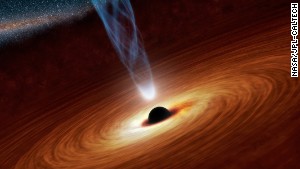
NASA says "The regions around supermassive black holes shine
brightly in X-rays. Some of this radiation comes from a surrounding
disk, and most comes from the corona, pictured here as the white light
at the base of a jet. This is one possible configuration for a corona -
its actual shape is unclear."
That light is getting
stretched and blurred, and researchers are getting to see it all in
unprecedented detail, said NASA in a news release issued today.
In this instance, the
corona -- a source of X-ray light that sits near a black hole --
recently collapsed in toward the black hole that's named Markarian 335.
The NuSTAR telescope has been collecting X-rays from black holes and dying stars for the past two years.
The craft completed its
primary mission earlier this year, and it was redirected to investigate
Markarian 335 once scientists noticed that the black hole had become
dramatically brighter. NuSTAR observed that Markarian 335's gravity
sucked the corona's light, an illuminating action that NASA likened to
someone shining a flashlight for astronomers.
Scientists can now see
the corona "lighting up material around the black hole," which allows
them to study "the most extreme light-bending effects" of Albert
Einstein's theory of general relativity, said NuSTAR's principal
investigator, Fiona Harrison, in the news release. She is with the
California Institute of Technology.
As if NuSTAR's
observations and Einstein's theories aren't mind-boggling enough, NASA
says the black hole Markarian 335 "spins so rapidly that space and time
are dragged around with it."
The space agency says the
new observations could help scientists better understand mysterious
coronas and black holes, which are thought to be formed when massive
stars collapse, creating such density that not even light can escape
their intense gravitational pull.
Scientists believe
supermassive black holes reside in the centers of galaxies. Some are
more massive and rotate faster than others.


No comments:
Post a Comment