
 Japan's new defense white paper has done little to mend fences with
Beijing, with the Chinese government complaining that its Asian neighbor
is using the "China threat" to justify a bigger defense budget.
Japan's new defense white paper has done little to mend fences with
Beijing, with the Chinese government complaining that its Asian neighbor
is using the "China threat" to justify a bigger defense budget.
Japan will spend about
$49 billion on defense in the fiscal year to March 2015 -- up about 3%
from the previous year -- in the face of what it says is a worsening
security environment in the region. It cites tensions on the Korean
peninsula and territorial disputes in the sea lanes running south from
northern Asia as its key concerns.
Under Prime Minister
Shinzo Abe, Japan is becoming more assertive about its defense posture,
and is looking to upgrade its military over the next four years with
bigger helicopter carriers, more anti-submarine patrol aircraft,
surveillance drones, better amphibious warfare capability, and first
deliveries in 2018 of its new fifth-generation fighter, the U.S.-made
F35 Joint Strike Fighter.
In terms of regional
defense, Japan benefits substantially from its security alliance with
the United States, and is a big buyer of U.S.-made weaponry. It also
builds its own submarines, surface ships and fighter variants.
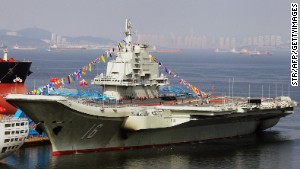
China, which will likely spend about $200 billion this financial year on
defense -- second only to the United States -- is a significant buyer
of Russian aircraft, ships and submarines, but is concentrating on its
own domestic capabilities. It launched its first aircraft carrier in
late 2012, with two more likely to be built by the end of this decade.
It is also developing its own fifth-generation stealth fighter, the
twin-engined J20, with the first deployment expected in 2018.
Dangerous activities
Japan's annual defense document,
approved by the Abe cabinet on August 5, says Chinese ships and
aircraft have engaged in "dangerous activities" in disputed areas such
as the South China and East China Seas, and these could have "unintended
consequences."
China's Defense Ministry quickly rejected the Japanese claim,
calling it simply an excuse for Japan's own military expansion. It said
it strongly opposed Japan's "ignorance of facts" and its "groundless
accusations" about China's military development.
Japan says China needs to
be more transparent about the reasons behind what Tokyo calls a "broad
and rapid" buildup of Chinese military might. It says China hasn't been
clear about the rationale for its expansion.
In the air, China
already has more frontline fighters than Japan, with the Chinese combat
arsenal including advanced Russian SU-27 and SU-30 planes, and the
domestic J10, J11 and J16. Japan has about 260 planes, including about
200 F15s, its mainstay fighter. Qualitatively, Japan still is seen to
have an edge because of its close integration with the Japan-based U.S.
military forces, in areas such as early warning, electronic warfare and
refueling. By 2018, that air superiority could tilt to China, depending
on how smoothly the roll-out proceeds respectively for China's J20 and
the Japanese variant of the U.S. F35.
U.S. pivot
For the United States,
the China-Japan defense spending spat is another point of Asia-Pacific
regional tension. The administration of U.S. President Barack Obama
wants to expand and maintain good relations with China, but is mindful
that Japan hosts most of the key U.S. forward bases in the region. Plus
there is a powerful economic incentive: Asia-Pacific continues to be a
major focus of arms sales for the U.S., in competition with Russia, some
European suppliers, and China itself.
According to the Stockholm International Peace Research Institute (SIPRI),
global military spending last year was about $1.75 trillion, with the
top 15 nations accounting for about $1.4 trillion of that. It ascribed a
figure of $640 billion to the U.S. in 2013, followed by China on $188
billion. Russia ranked third, with a 2013 spend of about $88 billion,
ahead of Saudi Arabia ($67 billion), France ($61 billion), UK ($58
billion), and Germany ($48.8 billion). Japan, India and South Korea
ranked 8th, 9th and 10th in 2013, according to SIPRI's calculations.
U.S. military spending
declined in 2013 and is budgeted to fall again in the year to September
2014 to about $526 billion. In contrast, SIPRI says that China, Russia
and Saudi Arabia have more than doubled their military spending since
2004.
Territorial spat
China and Japan have a
long-standing territorial dispute in the East China Sea over a group of
islands known in Japan as the Senkakus and in China as the Diaoyutai.
The islands lie about 111 miles (180 kilometers) northeast of Taiwan and
about 248 miles (400 kilometers) west of Okinawa.
The area has seen a
number of air and sea confrontations in recent years -- a point
highlighted in the Japanese defense white paper. It says: "China has
intruded into Japanese territorial waters frequently and violated
Japan's airspace by its government ships and aircraft belonging to
maritime law-enforcement agencies, and has engaged in dangerous
activities that could cause unintended consequences, such as its
vessel's direction of a fire control radar at a JMSDF destroyer, the
flight of fighters abnormally close to JSDF aircraft, and its
announcement of establishing the 'East China Sea Air Defense
Identification Zone' based on its own assertion thereby infringing the
freedom of overflight over the high seas."
In response, a Chinese
Foreign Ministry spokesperson said on August 8 that there was "nothing
disputable" about China carrying out "normal maritime and air activities
which are consistent with international laws and relevant domestic laws
and regulations." The spokesperson said China was exercising its
legitimate rights and interests in establishing the East China Sea ADIZ,
and was "in conformity with international laws and common practices."
Japan also has a
territorial dispute with South Korea over the Takeshima/Dokdo group of
islands in the Sea of Japan/East Sea. South Korea complained that the
Japanese defense white paper included the disputed islets as Japanese
territory and called on Japan to withdraw what it termed an "unjust
claim."
Further south, in the
South China Sea, China is in dispute with Vietnam, the Philippines,
Malaysia, Brunei, Indonesia and Taiwan over competing claims to various
islets and rocky outcrops.


No comments:
Post a Comment