
 American warplanes pounded extremist Sunni fighters in northern Iraq
on Saturday in what officials described as an effort to defend minority
Yazidis "being indiscriminately attacked," strikes that came just as
President Barack Obama warned of an extended air campaign against the
terror group.
American warplanes pounded extremist Sunni fighters in northern Iraq
on Saturday in what officials described as an effort to defend minority
Yazidis "being indiscriminately attacked," strikes that came just as
President Barack Obama warned of an extended air campaign against the
terror group.
The series of airstrikes
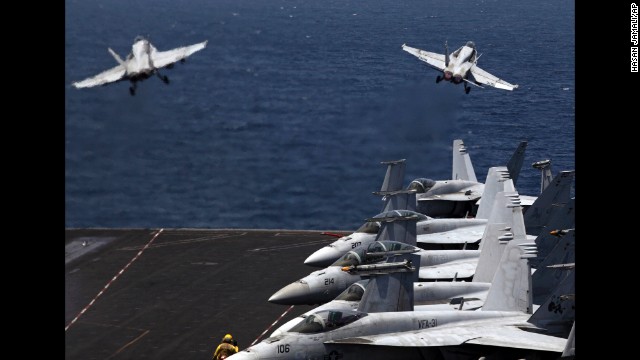
began with a mix of fighter jets and drones that targeted militants
firing on Yazidis near the town of Sinjar, where fighters with the
Islamic State, formerly known as the Islamic State of Iraq and Syria,
forced tens of thousands into hiding on nearby Sinjar Mountain.
The airstrikes were the
first in the Sinjar area since Obama authorized targeted attacks to
protect Americans and Iraqi minorities from an ISIS advance threatening
the Kurdish regional capital of Irbil.
News of the latest round
of airstrikes came as Obama declined to provide a timetable for U.S.
airstrikes and humanitarian aid drops in Iraq.
"I don't think we're
going to solve this problem in weeks," the President told reporters in
televised remarks, while at the same time reiterating a vow that no U.S.
combat troops will join the fight.
Given that Iraqi security
forces still need time to ramp up and Iraqi politicians need space to
form to form a more inclusive government to whittle Sunni support for
ISIS, "this is going to be a long-term project," Obama said from the
White House South Lawn.
The airstrikes on
Saturday began at about 11:20 a.m. ET, with the targeting of two ISIS
armored personnel carriers (APCs) firing on Yazidis, according to a
statement released by the U.S. Central Command. Another two rounds of
airstrikes were carried out about 20 minutes later after more ISIS
vehicles, primarily APCs, moved into the area, the statement said.
A fourth round of
airstrikes was carried out more than three hours later when U.S.
aircraft struck another ISIS armored vehicle, it said.
At the same time, health
and civil defense officials said U.S. warplanes targeted ISIS fighters
near the town of Makhmur, where the group has been launching attacks on
the outskirts of Irbil.
The Pentagon declined to
comment on the claims by Iraqi health and civil defense officials in
Mosul, who told CNN the airstrikes killed at least 16 of the fighters.
'Running out of time'
Meanwhile, the UK and
France has said it will join the United States in humanitarian airdrops
for hundreds of thousands of Iraqis on the run ahead of a brutal ISIS
advance.
On Saturday, the United
States carried out another round of airdrops. Three cargo aircraft --
supported by U.S. fighter jets -- dropped 3,804 gallons of fresh
drinking water and 16,128 ready-to-eat meals, the military said.
But a United Nations
official said airstrikes and humanitarian airdrops aren't enough for the
estimated 40,000 minority Yazidis, who are trapped on Mount Sinjar and
hiding from ISIS fighters who have said they will kill the group.
Only about 100 to 150
people a day have been able to be airlifted by Iraqi security forces off
the mountain, said Marizio Babille of UNICEF.
"We are running out of
time for thousands who can obviously not be reached by these airdrops,"
he said, adding that UNICEF is appealing for the international support
to open and secure "a humanitarian corridor over land."
 Dozens, including 60
children, according to UNICEF have died on the mountain where the
Yazidis are battling extreme temperatures and a lack of food and water.
Dozens, including 60
children, according to UNICEF have died on the mountain where the
Yazidis are battling extreme temperatures and a lack of food and water.
American planes also
have twice dropped food and other supplies to thousands of Yazidis,
members of a minority group that fled to a northern Iraqi mountain after
ISIS militants overran their town, Obama said Saturday.
U.S. aircraft are poised
to strike ISIS militants who have surrounded the mountain, Obama said.
Any such strikes would support Kurdish forces' efforts to free the
Yazidis, he said.
The airstrikes have
ramped up America's involvement in Iraq where ISIS is seizing control of
towns and key infrastructure even as it celebrates its own slaughter
along the way.
The United States has
hundreds of military personnel in Iraq, including advisers sent in
recent weeks to coordinate with Iraqi and Kurdish military officials in
response to the ISIS rampage. The USS George H.W. Bush and other Navy
ships also are in the region.
Obama indicated Saturday
the United States' interests in targeting ISIS went well beyond
protecting U.S. personnel and Iraqi minorities.
"My team has been
vigilant ... about foreign fighters and jihadists gathering in Syria and
now Iraq, who might potentially launch attacks outside of the region
against Western targets and U.S. targets," he said. "So there's going to
be a counterterrorism element that we are already preparing for and
have been working diligently on for a long time now."
Obama: Iraq's ethnic groups need to unite
Asked Saturday if Obama
felt ISIS had been underestimated, the President said the advance of the
Sunni Islamic extremists has been "more rapid" than intelligence
officials and policymakers, both inside and outside Iraq, had predicted.
But he said ISIS' advance was made possible in part by the lack of an inclusive and functioning Iraqi government.
The government forces,
"when they (were) far away from Baghdad, did not have the incentive or
the capacity to hold ground against an aggressive adversary," Obama
said.
To secure their country,
Iraqis will need to build an inclusive government, Obama said, in an
apparent dig at Prime Minister Nuri al-Maliki's Shiite-dominated
government.
Iraq's Sunni minority
have bitterly complained of being marginalized and cut out of the
political process by al-Maliki's government.


No comments:
Post a Comment