
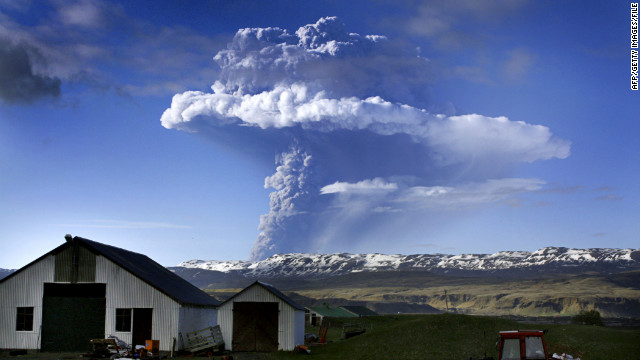
 In 2010, an Icelandic volcano with an unpronounceable name spewed an
ash cloud into the skies that disrupted travel for millions of
passengers and cost airlines a small fortune.
In 2010, an Icelandic volcano with an unpronounceable name spewed an
ash cloud into the skies that disrupted travel for millions of
passengers and cost airlines a small fortune.
Now another Icelandic
volcano is rumbling, prompting fears of a repeat of the travel chaos
that afflicted northern Europe when the Eyjafjallajokull volcano did its
worst.
Its name -- Bardarbunga -- is a little less daunting, but it could still cause trouble.
Something is brewing
While there's no sign yet
of magma moving to the surface, according to Iceland's Meteorological
Office, something's definitely up beneath the Earth's surface.
In what the
Meteorological Office describes as an "intense earthquake swarm,"
scientists registered some 2,600 earthquakes between early Saturday
morning and Monday evening.
And after the strongest
earthquake since 1996 was measured in the area early Monday, an orange
aviation alert was posted by Icelandic authorities -- indicating
"heightened or escalating unrest with increased potential of eruption."
"The reason we are
reacting in this way is that this one is bigger and more powerful than
we have seen in a long time in this area," said Vidir Reynisson, of the
Iceland Civil Protection Agency, of the earthquake swarm.
Scientists have noticed
an increase in seismic activity around the volcano, located in the
northwestern region of Vatnajokull glacier, one of Europe's largest
glaciers, over the past seven years, the Meteorological Office said.
The level dropped a
little after the eruption of another volcano on the same glacier,
Grimsvotn, in 2011, but has since picked up again.
Earthquakes may signal eruption
As of Monday evening,
the majority of earthquakes measured were at a depth of 5 to 10
kilometers. There's more potential for a volcanic eruption if magma
movement occurs at less than 10 kilometers' depth.
According to the Smithsonian Institute Global Volcanism Program, Bardarbunga last erupted in 1910.
If it should blow its top again, it could be bad news for travelers.
Volcanic ash can be a
serious hazard to aircraft, reducing visibility, damaging flight
controls and ultimately causing jet engines to fail.
The Eyjafjallajokull eruption forced the cancellation and diversion of thousands of flights per day at the peak of the problem.
"It was causing problems
for millions of passengers, the airlines themselves were losing lots of
money because they could not fly," Paul Charles, former director of
communications for Virgin Atlantic and Eurostar, told CNN.
"And the customer
relations departments of airlines were really suffering because they
were taking huge numbers of complaints and they had no solution."
Air travel still smooth
Europe's air authority,
Eurocontrol, said Tuesday it was monitoring the Bardarbunga situation
but that there is no impact at this time on European aviation. It also
insists that changes have been made to help avoid the kind of chaos seen
after Eyjafjallajokull erupted.
"Europe is more prepared
to deal with volcanic ash these days; we have better mechanisms in
place than we did in 2010. Every year, volcanic ash exercises are
conducted and we learn from them: the latest one was held in April this
year," it said.
"However, volcanic ash
is still a hazard for aviation and does have the potential to cause
disruption. Safety is, as ever, our primary concern."


No comments:
Post a Comment