
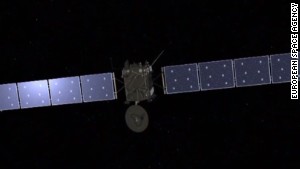
 After a 10-year chase taking it billions of miles across the solar system, the Rosetta spacecraft made history Wednesday as it became the first probe to rendezvous with a comet on its journey around the sun.
"Thruster burn complete. Rosetta has arrived at comet 67P. We're in orbit!" announced the European Space Agency, which is leading the ambitious project, on Twitter.
Rosetta fired its
thrusters on its final approach to Comet 67P/Churyumov-Gerasimenko,
known as "Chury" for short, on Wednesday morning. Half an hour after the
burn, scientists announced that the craft had entered into the orbit of
the streaking comet.

"Europe's Rosetta is now
the first spacecraft in history to rendezvous with a comet, a major
highlight in exploring our origins. Discoveries can start."
 ESA tweeted a photo of the comet
after Rosetta's maneuver. Chury and the space probe now lie some 250
million miles from Earth, about half way between the orbits of Jupiter
and Mars, according to ESA.
ESA tweeted a photo of the comet
after Rosetta's maneuver. Chury and the space probe now lie some 250
million miles from Earth, about half way between the orbits of Jupiter
and Mars, according to ESA.
The first spectacular and
detailed images taken from just 80 miles away shows boulders, craters
and steep cliffs and are already causing excitement.
"Churyumov-Gerasimenko
looks like it's been through the wars!" said Dr Robert Massey of the
Royal Astronomical Society in the UK.
"With that odd looking
'neck', either we're looking at two objects that merged together or so
much material has been lost in its many passes around the sun that the
comet is a shadow of what it started out as.
"The pictures coming
back so far look intriguing -- and imagine the kind of scenes we can
expect when Philae lands this coming November," he said.
To get to its
destination the spacecraft has covered more than three billion miles and
as the comet hurtles towards the sun it will reach a speed of about
62,000 miles per hour.
The mission has now
achieved the first of what it hopes will be a series of historic
accomplishments. In November mission controllers aim to place the
robotic lander Philae on the surface -- something that has never been
done before.


No comments:
Post a Comment