
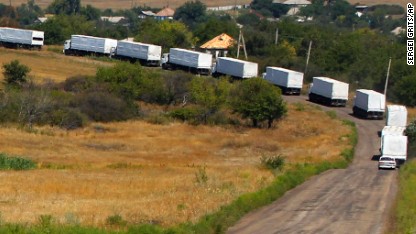
 The presence of Russian vehicles in Ukraine is an "unauthorized entry"
and the personnel and vehicles must be removed immediately, Pentagon
spokesman Rear Adm. John Kirby told reporters Friday. No Russian
personnel should enter Ukraine under the guise of a humanitarian convoy,
Kirby said.
The presence of Russian vehicles in Ukraine is an "unauthorized entry"
and the personnel and vehicles must be removed immediately, Pentagon
spokesman Rear Adm. John Kirby told reporters Friday. No Russian
personnel should enter Ukraine under the guise of a humanitarian convoy,
Kirby said.Russia has up to 18,000 "combat-ready" troops on its border with Ukraine on Friday, a significant increase from previous public estimates by the Pentagon, according to a U.S. defense official with direct access to the latest information.
The official described the units as being in a "fully combat-capable offensive posture."
A second U.S. official said that many of the units were positioned at "crossroads and towns" 2 to 10 miles from the border.
"They are definitely more overt, aggressive and out in the open," the official said. "They aren't even hiding it."
The second official said
the United States has believed for weeks that some Russian troops have
crossed the border as part of the convoys of military gear and weapons
moving from Russia into Ukraine. Of particular concern is the apparent
transport of long-range and advanced systems including at least two
SA-22 surface to air missile system and a number of pieces of
longer-range artillery.
The show of force comes
on the same day a Ukrainian official accused Russia of directly invading
the country under the guise of humanitarian aid after Ukraine's
military said part of a Russian aid convoy violated an deal by entering
Ukraine without Red Cross monitors.
Russia sent 34 trucks
from an aid convoy into eastern Ukraine after Russian and Ukrainian
customs officials cleared them under the assumption that the
International Committee of the Red Cross would be with them, the
Ukrainian military said.
But the Red Cross said
it was no longer with the convoy because of the "volatile security
situation," a reference to fighting between pro-Russian rebels and
Ukrainian forces.
In total, at least 134
Russian vehicles in the aid convoy had entered Ukraine as of 2:20 p.m.,
according to the Organization for Security and Co-operation in Europe,
which has an observer mission at the checkpoint the convoy is passing
through.
NATO Secretary General
Anders Fogh Rasmussen on Friday condemned the "entry of a Russian
so-called humanitarian convoy into Ukrainian territory without the
consent of the Ukrainian authorities and without any involvement of the
International Committee of the Red Cross."
"It can only deepen the
crisis in the region, which Russia itself has created and has continued
to fuel," he said in a statement. "The disregard of international
humanitarian principles raises further questions about whether the true
purpose of the aid convoy is to support civilians or to resupply armed
separatists."
The unaccompanied trucks
effectively constitute a Russian invasion of Ukraine, said Valentyn
Nalyvaychenko, the head of Ukraine's security service.
"We call this a direct invasion for the first time under cynical cover of the Red Cross," Nalyvaychenko said Friday.
The news was the latest flashpoint in tensions between Moscow and Kiev,
which for months has accused Russia of sending supplies into Ukraine to
support pro-Russian rebels in Ukraine's east.
Ukraine, as of now,
doesn't plan to use force against the convoy, though Kiev suspects that
the trucks' supplies will be given to rebels, Nalyvaychenko said.
Meanwhile, another 90
vehicles are headed toward the Ukrainian border, according to Col.
Andriy Lysenko, spokesman for Ukraine's National Defense and Security
Council. Ukrainian border guards, customs officers and Red Cross
representatives have not been given access to that group, Lysenko said.
He said that the Ukrainian side had proposed talks with Russia over the humanitarian aid but that Moscow had refused.
The trucks were part of a
larger convoy that left the Moscow area last week, with Russia
insisting that it be allowed to send aid to civilians -- many of them
Russian speakers -- affected by the months of fighting in eastern
Ukraine. Aid groups say the battles have left thousands without access
to water, electricity and proper medical aid.
Ukraine, concerned that
Russia might try to smuggle military supplies, stalled the trucks for
days on the Russian side of the border.
But Ukrainian officials
acknowledged Sunday that the convoy of more than 260 Russian vehicles
was, in fact, carrying humanitarian aid.
Red Cross monitors were
supposed to accompany the initial 34 vehicles but decided not to do so
because they did not get the security guarantees they needed, the agency
said.
Russia's Foreign
Ministry said the first group of trucks was headed toward Luhansk, one
of two Ukrainian regions at the center of the conflict.
Russian state news agency Itar-Tass said the initial convoy carried food and essential items for people in the region.
Ukraine's National
Security and Defense Council said Friday that the customs service had
granted access for 34 vehicles, 34 people and 268,020 kilograms of
Russian humanitarian aid.


No comments:
Post a Comment