
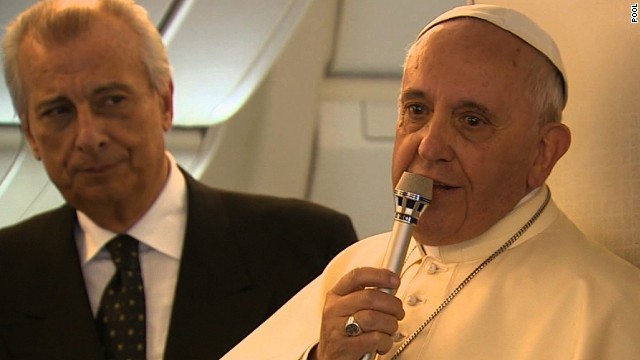
 Pope Francis' trip to South Korea
memorialized the atrocities of the last century. On the way home, the
Pope became embroiled in controversy about a conflict raging in the current one.
Pope Francis' trip to South Korea
memorialized the atrocities of the last century. On the way home, the
Pope became embroiled in controversy about a conflict raging in the current one.
During a lengthy
discussion, Francis remarked on the spread of cruelty and torture before
being asked about violence against religious minorities in Iraq, and
whether he approved of the U.S. bombing campaign aimed at stopping the
Islamic State of Iraq and Syria, or ISIS. With what seemed careful
deliberation, Pope Francis said: "In these cases where there is an
unjust aggression, I can only say this: It is licit to stop the unjust
aggressor. I underline the verb: stop. I do not say bomb, make war, I
say stop by some means. With what means can they be stopped? These have
to be evaluated. To stop the unjust aggressor is licit."
This response -- and the
reaction to it -- says much about the complexity of running an
organization that is at once modern and ancient, religious and
political, international and parochial. But what exactly did he mean?
Was he, as a few excitable writers suggested, calling for a new crusade?
Certainly, much of the media response quickly fixated on what seemed to
be approval for a military campaign and how a Pope -- the leader of the
Catholic Church -- was seemingly sanctioning war against an Islamic
caliphate.
Actually, he wasn't.
Crusading, as defined by
most historians, generally involved taking religious vows to head east
and assist in military expeditions against Islamic powers in exchange
for spiritual rewards (redemption from sin). Historians have identified
major campaigns as the First, Second, Third, etc. Crusades. In response to these conquests, the local Islamic powers leveraged the idea of jihad to rally disparate Muslim groups together.
Yet although the Crusades
featured not just plenty of violence but also peaceful cross-cultural
exchange, they aren't an example Francis wants to invoke. In fact, he
isn't saying that anyone should take vows and go off to fight. Instead,
Francis is making the point that taking action to stop evil is just.


No comments:
Post a Comment