
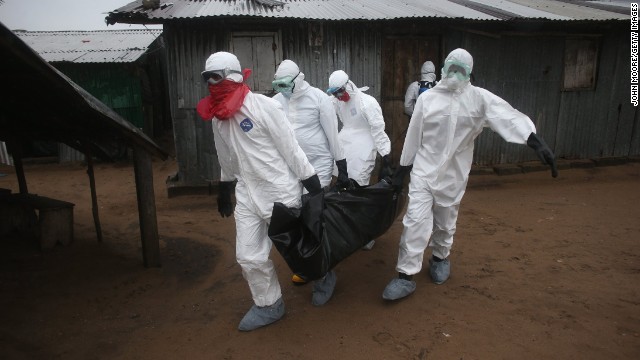
 Three health care workers who were given the experimental Ebola drug
ZMapp in Liberia have shown "very positive signs of recovery," the
Liberian Ministry of Health said Tuesday.
Three health care workers who were given the experimental Ebola drug
ZMapp in Liberia have shown "very positive signs of recovery," the
Liberian Ministry of Health said Tuesday.
Medical professionals treating the workers have called their progress "remarkable."
The good news comes as
the number of deaths from the outbreak in West Africa climbed to 1,229,
according to the World Health Organization.
The Liberian government also reported that all 17 patients who fled a local clinic after it was attacked earlier this week have been accounted for. Those who tested positive for Ebola are now being treated at another medical center.
The government met with
local community leaders and concluded the attack stemmed from a
misunderstanding; locals thought the clinic was "importing Ebola victims
from the rest of the country," according to health officials. Looters
who took a generator, mattresses and critical medical supplies have
promised to return the items.
There are other small
signs of hope amid the largest Ebola outbreak in recorded history. WHO
has seen "encouraging signs" from Nigeria and Guinea that positive
action can rein in the deadly disease. The current outbreak began in
December.
The situation in Lagos, Nigeria, where the country's first case was detected in July, "looks reassuring," WHO said Tuesday.
"At present, the city's
12 confirmed cases are all part of a single chain of transmission. Those
infected by the initial case include medical staff involved in his
treatment, a patient in the same hospital, and a protocol officer in
very close contact with the patient," the organization said.
No one on the same flight
as the man who carried the infection into the country on July 20 was
infected, despite him vomiting frequently on the flight and on arrival,
it said. The man died July 25 and the 21-day incubation period has now
passed, the WHO said.
Intensive efforts to track those at risk have not turned up any new cases outside the 12 identified.
One of those 12 has made
a full recovery, the WHO said, which "counters the widespread
perception that infection with the Ebola virus is invariably a death
sentence." Evidence suggests early detection and therapy can help people
survive, it said.
"The intensity of the
search and monitoring effort raises cautious optimism that further
spread of the virus in Nigeria can be stopped. The search for additional
cases continues, as does the current high level of vigilance."
In Guinea, the situation
is "is less alarming" than in Liberia and Sierra Leone, the WHO said,
thanks to higher awareness and innovative efforts to contain the spread
of the virus.
Community leaders have
persuaded 26 villages that were resistant to outside help to cooperate,
it said. As a result there has been a surge in reported cases -- but
these are cases that were previously concealed, so they should not be
seen as surge in infections.
But despite the positive
signs, the WHO warned that the outbreak is not under control and that
progress is fragile, with a real risk of another flare-up and the
continued spread of the disease.
The WHO on Monday called
on the affected countries to carry out exit screenings of travelers at
international airports, seaports and major land crossings.
But it said it doesn't
currently recommend travel restrictions and active screening of
passengers on arrival in countries that don't have borders with the
affected countries.


No comments:
Post a Comment