
 It was the height of the
Cold War and the United States and the Soviet Union were battling it out
to be the first nation to put a man on the lunar surface. On July 20,
1969, eight years after President Kennedy implored the U.S. congress for
funding for space exploration, NASA's Apollo 11 spaceflight touched down on the moon. American astronauts Neil Armstrong and Buzz Aldrin became the first humans in history to walk on the Earth's nearest neighbor.
It was the height of the
Cold War and the United States and the Soviet Union were battling it out
to be the first nation to put a man on the lunar surface. On July 20,
1969, eight years after President Kennedy implored the U.S. congress for
funding for space exploration, NASA's Apollo 11 spaceflight touched down on the moon. American astronauts Neil Armstrong and Buzz Aldrin became the first humans in history to walk on the Earth's nearest neighbor.
Since then a further 10
men have left their footprints on the moon's dusty surface, with the
last being Apollo 17 astronaut Eugene Cernan in 1972. But after this
golden age, moon exploration was seen as not cost effective for
international space agencies.
Then, last year, China sent its Jade Rabbit explorer on a three-month mission to examine the moon's crust. But it suffered a critical malfunction just half way through and bid farewell to humanity in a final report (although it is still functioning,
according to Chinese press reports). Now Google is shooting for the
stars and calling for private organizations to participate in an
international competition for innovators to go back to the moon.
The Google Lunar X Prize
hopes to spur exploration on the moon and will see a hefty $20 million
jackpot handed to the first team that puts a robot on the lunar surface.
But that's not all --
there are a few scientific objectives a team must complete in order to
obtain the ultimate honors from Google. Once on the moon, the robot must
travel 500 meters and transmit HD video back to Earth. And they've got
to do it all by December 31, 2015.
Inspiring innovators
"Competition leads to
innovation, and the Google Lunar X Prize has brought together some of
the brightest and most talented minds to accelerate the private NewSpace
sector," says Chanda Gonzales, senior director of the Google Lunar X
Prize.
"We are encouraged to
see this prize pushing the industry to take risks and invest in
cutting-edge technologies to support lunar exploration, which will
result in an entirely new economy around low-cost access to the moon and
beyond."
It is now seven years
after the prize was launched and 18 private teams remain in the running.
Working tirelessly to secure funding (only 10% of financing can come
from government sources) as well as designing and building their
individual modules, these international innovators are finally moving
into the testing phase.
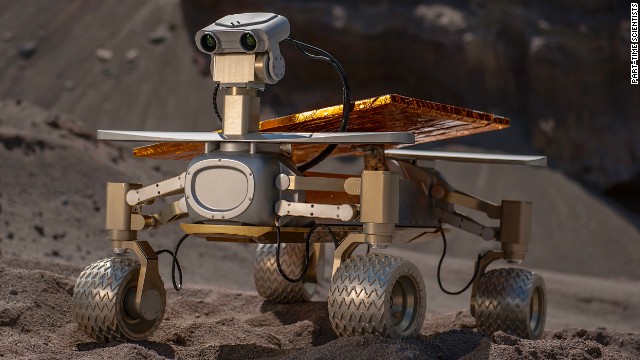 U.S.-based company Astrobotic was set up off the back of the competition's announcement, said John Thornton, the company's CEO.
"The Google Lunar X
Prize is a catalyst to get started but it is not the end game. What
we're doing as a company is creating a long-term sustainable business of
carrying payloads to the moon so it's like UPS or a FedEx truck that
flies regularly to the moon."
In partnership with
students from Carnegie Mellon University, in Pittsburgh, Pennsylvania,
Astrobotic is building a lander and a rover as part of its Skylight
mission to travel to the rather dramatically named Lacus Mortis --
meaning "Lake of Death." The team hopes to explore a pit that it
suspects could be linked to a larger cave network underneath the moon's
surface.
Journeying to the 'Lake of Death'
"We think that the right
way to settle the moon is underground first. You go underground, you
pop up an inflatable or a small habitat under there and you have natural
protection from the elements. You're protected from micrometeorites
that come in and the moon doesn't have an atmosphere to burn them up.
You're protected from radiation," says Thornton.
"It's much easier to
sustain long-term life on the surface of the moon so it's really a
game-changer in the catalyst of the future of the moon. That's why we go
there for the first mission: to explore, to see what these [pits] are
about, and to cast the vision for the future."
The Astrobotic team will
be going down to the wire as it works towards a tentative launch date
at the end of 2015 -- right before the competition deadline. And it
won't be the only team holding its breath. As part of its funding
strategy, Astrobotic has offered to bring up several other prize
contenders, essentially creating a secondary moon race within the
competition.
Thornton explains:
"We'll have other rovers that will deploy from our lander and those
rovers will drive out and try to win the X Prize. It will be very much
like NASCAR happening live on the moon now and the world will be able to
watch, which will be incredibly exciting.
"What you don't want is a
provider like us being incentivized to place first and everyone else to
come in last. That's not a good scenario for a partnership so the way
we've modeled it is in a way that the partners can win and it helps
everyone. It's really like a 'coop-petition,'" he adds.
Despite millions of
dollars at stake, the Skylight mission comes before the competition,
says Thornton. "The mission is more important for us. The X Prize teams
will be a small portion of the total payload that flies ... When we land
we'll have payloads from all over the world landing and doing various
missions, sub-missions and objectives."
A moon bunny?
Another team hoping to reach the lunar surface is Moon Express, which is building a hopper to bounce across the rocky terrain.
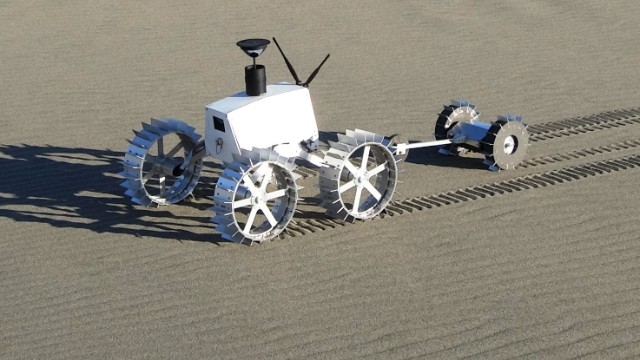 "When you are on the
moon you have one-sixth gravity and there's no air resistance so we kind
of use those to our advantage. And since we already have a spacecraft
already designed to autonomously land, it's pretty trivial for it to
repeat that and just hop," says the company's public outreach liaison
Brad Kohlenberg.
"When you are on the
moon you have one-sixth gravity and there's no air resistance so we kind
of use those to our advantage. And since we already have a spacecraft
already designed to autonomously land, it's pretty trivial for it to
repeat that and just hop," says the company's public outreach liaison
Brad Kohlenberg.
Competitions like this
offer the opportunity to get closer to untapped resources as well as
inspire future generations, adds Kohlenberg.
"It is recreating what
we call the ' Apollo effect,'" he says. "During the Apollo program, we
inspired a generation of children who grew up to build their own
industries and companies and now these billionaires are reinvesting and
building things, investing in space companies.
"You have Virgin
Galactic from Richard Branson, you have Elon Musk -- all these people
that are called 'Orphans of Apollo' -- people who grew up thinking they
would go to college in space and then once they got there, realizing
that the space program kind of left them behind and so now they are
using their own resources to reinvest in that and make the dreams they
had when they were younger a reality."
'It's not about scientific discovery'
For space scientist Lucie Green, this competition is more about technological payoff than scientific discovery.
"These missions are
always about process," she says. "So the first mission is about
technology -- can we get there? Can we build something that is robust
enough to survive in the extreme environment of space? And then the
science comes later. So I think first of all, this is very much about a
technology development."
Green, who is a Royal Society University Research Fellow
based at the Mullard Space Science Laboratory at the University College
London, uses Mars as an analogy to reveal why it isn't necessarily a
bad thing that little scientific research will come out of this
particular endeavor.
"The first technology to
land on the surface of Mars was primitive really. It was all about
getting to the Martian surface and surviving and here we are several
decades after the Viking landed and we're still looking for life, we're
still looking at challenging questions. You go, you learn, you feedback.
You develop new instrumentation that's more capable, that can record
more data, can transmit more data, and can be more sophisticated each
time."


No comments:
Post a Comment