
 More than half a century after Sputnik, space travel remains
shockingly wasteful. Every rocket we launch at the cost of hundreds of
millions of dollars can only be used once and completes its mission by
falling to Earth in pieces. This disposable design has scarcely advanced
since the 1960s.
More than half a century after Sputnik, space travel remains
shockingly wasteful. Every rocket we launch at the cost of hundreds of
millions of dollars can only be used once and completes its mission by
falling to Earth in pieces. This disposable design has scarcely advanced
since the 1960s.
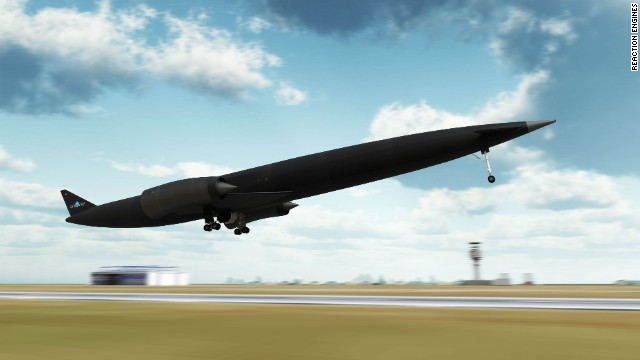
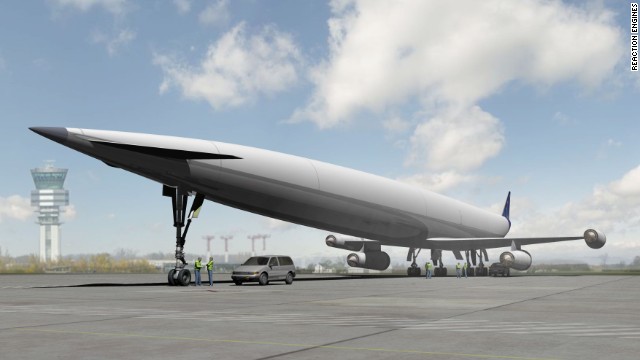
British engineer Alan Bond has been developing a new concept for over 30 years, and is now on the verge of achieving it. His Skylon "spaceplane" design
is intended to withstand multiple uses and requires minimal repairs and
turnaround time, so it can function as a rapid response unit for space
missions, and go far beyond the existing horizons.
"The intention is to
replace existing rockets," Bond says. "The technology we are working on
would enable more frequent and reliable missions by large factors."
Central to the design is a
HOTOL (Horizontal Take Off and Landing) system similar to a regular
plane -- albeit from a much longer runway -- so that the craft returns
intact. Beyond this, Bond's team at Reaction Engines Ltd. has invented
multiple new technologies, most crucially an ingenious concept engine,
the SABRE (Synergistic Air-Breathing Rocket Engine).
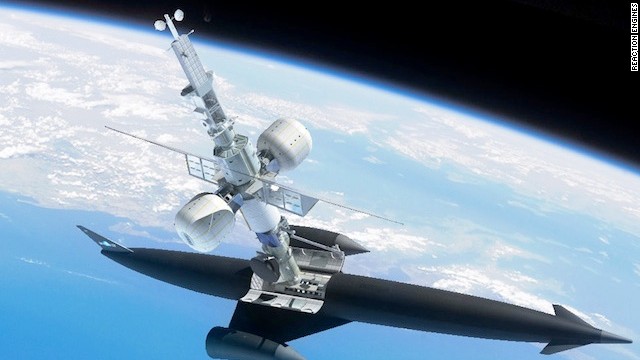 While existing rockets
carry several heavy fuel tanks that are worked through and jettisoned
over the course of the journey, SABRE powers the craft from a single
chamber carrying liquid oxygen and liquid hydrogen. It minimizes the
load by taking in oxygen from the atmosphere during the ascent, which is
cooled and and combined with hydrogen to make fuel. Once the craft
reaches an altitude of 28 kilometers the engine converts to using the
stored liquid oxygen.
While existing rockets
carry several heavy fuel tanks that are worked through and jettisoned
over the course of the journey, SABRE powers the craft from a single
chamber carrying liquid oxygen and liquid hydrogen. It minimizes the
load by taking in oxygen from the atmosphere during the ascent, which is
cooled and and combined with hydrogen to make fuel. Once the craft
reaches an altitude of 28 kilometers the engine converts to using the
stored liquid oxygen.
Read: Have a taste of the world's first stem cell burger
"We have passed the major
obstacles, and what we have now are normal engineering problems," says
Bond. "It's about designing and testing, but there's no question that
with the physics efficiencies the engine depends on -- we're there."
The European Space Agency (ESA) agrees,
having approved the mechanisms of the engine in a series of tests. "The
idea has been around since the 1950s but this is the first time anyone
has managed to achieve a working system," said ESA head of propulsion
Mark Ford.
Progress has been steady,
with day-to-day work on readying SABRE for test flights that Bond says
could take place as early as 2018.
The ESA has also praised
the economic model, claiming the Skylon could meet its launch cost
target of €70 million ($94 million), in addition to the efficiency
savings of being able to repeatedly reuse the same craft.
Bond sees Skylon's
primary initial use being in cargo -- "essentially a truck to haul kit
cheaply into space on a very regular basis." This would dramatically
reduce the logistical headaches involved in routine tasks such as
repairs to the International Space Station, or transporting satellites.
But once the concept is
proven as easier and more efficient, it can be applied to far more
ambitious targets. Bond sees human colonization of other planets as
inevitable and necessary, and feels his system can be applied to deep
space exploration and the study of exoplanets, as well as enabling rapid
construction on them that would precede habitation.
Experts believe a paradigm shift is necessary to revitalize the field of space exploration.
 "There would need to be
an increased rate of flights to lower the cost of an initially more
expensive launch system," says David Baker of the British Interplanetary Society.
"But if there were 100 a year the cost would fall through the floor ...
It's the very thing that's needed not only to service the existing
industry but also to open broader applications."
"There would need to be
an increased rate of flights to lower the cost of an initially more
expensive launch system," says David Baker of the British Interplanetary Society.
"But if there were 100 a year the cost would fall through the floor ...
It's the very thing that's needed not only to service the existing
industry but also to open broader applications."
The market exists to
support such a rate of flights, says Baker, detailing a huge backlog of
potential clients from universities to enthusiasts ready with
experimental missions and payloads should cost and logistics become more
manageable. Even intercontinental flights could make use of
hypersonic-enabled engines.
Baker also points to Elon Musk's reusable "Falcon spacecraft"
to show the growing feasibility and popularity of multi-use designs.
The concept must reach popular acceptance, but could be "absorbed into
the commercial world in the next decade or two," he says.
The Skylon could be in
operation far sooner than that, with tentative plans to reach the
International Space Station by 2022. Beyond this, the horizon goals of
exploring the universe from mining resources to finding life to the
colonization of planets will follow.


No comments:
Post a Comment