
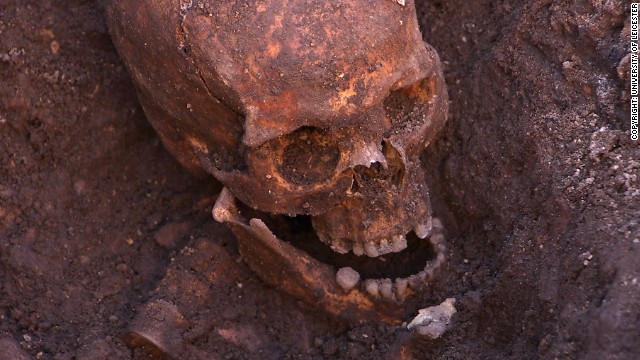
 Tests on the long-lost skeleton of Richard III reveal the medieval
monarch had a taste for rich foods such as peacock, heron and swan, and
that his liking for the finer things in life -- including wine --
increased significantly after he became the king of England.
Tests on the long-lost skeleton of Richard III reveal the medieval
monarch had a taste for rich foods such as peacock, heron and swan, and
that his liking for the finer things in life -- including wine --
increased significantly after he became the king of England.
Scientists at the British
Geological Survey measured the levels of isotopes including oxygen,
strontium, nitrogen and carbon in the remains of Richard III, found
buried beneath a parking lot in the English city of Leicester in 2012.
In a paper published in
the Journal of Archaeological Sciences, they say the tests can reveal
clues as to where a person lived, and what they ate and drank, allowing
experts "to reconstruct the life history" of the last Plantagenet king.
The remains of King Richard III
Isotope geochemist Angela
Lamb, who led the study, said two teeth -- a molar and premolar -- and
two bones -- a rib and femur -- were analyzed because each held
different information and could offer a variety of clues to Richard
III's life.
"The teeth develop in
childhood and don't change, so from them we can get information about a
person's early years," she told CNN.
"Bones are different;
they remodel and repair themselves through life -- if you break a bone,
for example, it can heal. The femur is dense and slow-growing, so it can
tell us about the last 10 to 15 years of a person's life, whereas the
rib bone is much more spongy and regenerates much more quickly, so it
can reveal information about the last two to three years."
High-protein diet
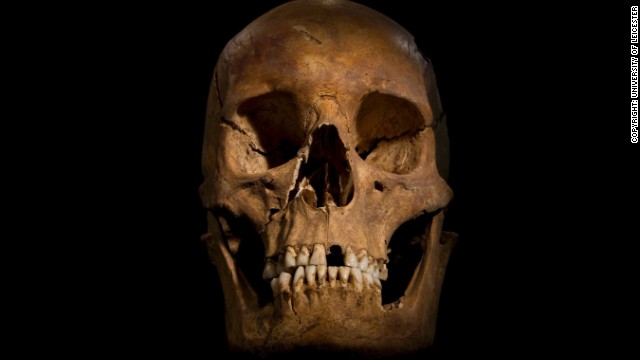 This is key in the case
of Richard III, since he became king just 26 months before his death at
the Battle of Bosworth in 1485 -- and analysis suggests his diet changed
markedly in the few short years after he was crowned.
This is key in the case
of Richard III, since he became king just 26 months before his death at
the Battle of Bosworth in 1485 -- and analysis suggests his diet changed
markedly in the few short years after he was crowned.
Medieval aristocrats are known to have eaten high-protein diets full of freshwater fish and
wildfowl, in part
because of religious observances which called for "meat-free" fasting
for up to a third of the year. Fish and wildfowl -- birds such as heron,
swan and egret -- were not considered meat.
"Obviously, Richard was a
nobleman beforehand, and so his diet would be reasonably rich already,"
explained Lamb. "But once he became king we would expect him to be
wining and dining more, banqueting more. Food was a real mark of status
in the medieval period.
"We have the menu from
his coronation banquet and it was very elaborate -- lots of wildfowl,
including real 'delicacies' such as peacock and swan, and fish -- carp,
pike and so on, which were cultivated in special fishponds."
Matching up historic
records from the king's lifetime with brand new scientific data
harvested from his remains has offered experts a unique opportunity to
"cross-check" what is already known about his life and times.
As Richard Buckley, the
University of Leicester archaeologist in charge of the dig which
uncovered the king's remains, explained: "It is very rare indeed in
archaeology to be able to identify a named individual with precise dates
and a documented life.
"This has enabled
stable-isotope analysis to show how his environment changed at different
times and, perhaps most significantly, identified marked changes in his
diet when he became king in 1483."
Isotope analysis backs
up many of the records of Richard's life -- that he was born in eastern
England but spent part of his childhood in western Britain. And knowing
where he lived, from ancient documents, allowed the experts to learn
something new about isotope analysis.
"By looking at the
levels of oxygen isotopes, we can tell where a person lived, because the
oxygen comes from the drinking water that they consumed," said Lamb.
"In this case, the
isotopes suggested that [towards the end of his life] Richard was living
in the extreme southwest of Britain, but we know from the records that
this isn't the case, so we had to look for another explanation."
Wine habit
Given the discoveries
they had already made about Richard's extravagant diet, they began to
wonder if the discrepancy in oxygen isotopes pointed to the fact he was
drinking something other than water.
Brewing water into ale is known to alter isotope levels, but beer was not a high-status drink in the medieval era.
"We needed something
that would tie in with the luxury food he would have been eating," said
Lamb. "Back then wine was very much the preserve of the upper classes --
it was imported, expensive and only the very wealthy could afford it."
By carrying out tests
with modern equivalents, the scientists were able to conclude that
Richard drank up to a bottle of wine a day -- and to work out, for the
first time, that wine consumption effects oxygen isotope levels.
"It is fascinating,"
said Lamb. "We use these techniques all the time, but we are never able
to 'cross-check' them, and it is only his which enabled us to figure it
out."


No comments:
Post a Comment