
Down on Earth, we all know: Do anything stupid these days, and video of it will turn up on the Internet to embarrass you.
 Now, space aliens may be about learn that lesson, too.
NASA deployed live webcams on the International Space Station
in March, and UFO enthusiasts monitoring their live feeds online have
nabbed unidentified flying objects scooting through Earth's orbit.
Now, space aliens may be about learn that lesson, too.
NASA deployed live webcams on the International Space Station
in March, and UFO enthusiasts monitoring their live feeds online have
nabbed unidentified flying objects scooting through Earth's orbit.
 NASA is separately
experimenting with using a laser beam to transfer data to Earth.
Researchers hope it will speed up data transfer by 10 to 100 times. The
idea is to zap massive amounts of data to scientists, but it could also
make for very high-quality video streams.
NASA is separately
experimenting with using a laser beam to transfer data to Earth.
Researchers hope it will speed up data transfer by 10 to 100 times. The
idea is to zap massive amounts of data to scientists, but it could also
make for very high-quality video streams.

 Now, space aliens may be about learn that lesson, too.
They've made screen grabs
of the NASA video and posted them online. UFOlogist Scott Waring may
have been the first, when he plastered them onto his blog, UFO Sightings Daily, early last week.
Highlighted by a red circle and clearly visible is -- a speck. A white one. An enlargement of the screen grab reveals -- a blur.
A note explains the
alleged vehicle's shape: "It has a long line down its middle and a dome
on its top, but is rectangle on it lower bottom."
If you still don't
recognize it, don't worry, it's not called "unidentified" for nothing.
And it's hard to know for sure what it is, with all the meteors,
satellites and space junk swarming around Earth.
A few days later, a similar post turned up of another white speck spied by a space station lens as it pulsates and fades away.
Look down
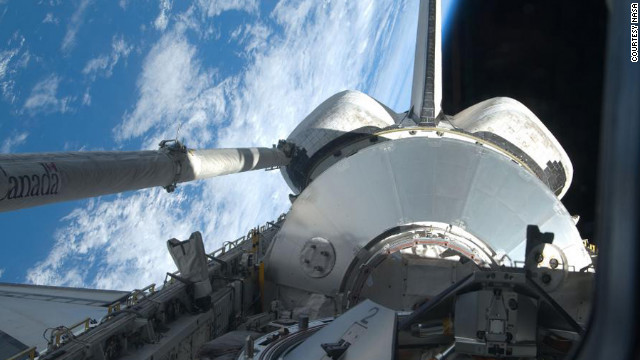
Sleuthing for extraterrestrials was not NASA's intention when it attached the four high-definition cameras to the space station.
They offer live views of
Earth's terrestrial greens and browns, atmospheric and oceanic blues,
and cloudy swaths of white as the space station races around the planet
once every 90 minutes.
And they are a high school science project.
Students designed some
of the hardware components in the overall system in a project with NASA
called HUNCH, or High Schools United with NASA to Create Hardware.
Its aim is to figure out
how conditions in space, like high radiation, affect video quality to
help decide what kind of cameras to use on future missions.
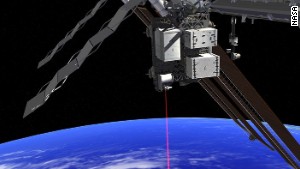
 NASA is separately
experimenting with using a laser beam to transfer data to Earth.
Researchers hope it will speed up data transfer by 10 to 100 times. The
idea is to zap massive amounts of data to scientists, but it could also
make for very high-quality video streams.
NASA is separately
experimenting with using a laser beam to transfer data to Earth.
Researchers hope it will speed up data transfer by 10 to 100 times. The
idea is to zap massive amounts of data to scientists, but it could also
make for very high-quality video streams.
Aliens on the Internet?
The cameras for the Earth viewing are consumer grade, off the shelf.
But they are apparently
good enough to snag alien vessels, which may not have journeyed too
terribly far to visit Earth's orbit, according to UFO Sightings Daily.
Trawling NASA images for
proof of intergalactic visitors to our solar system has gone on since
NASA started snapping the images decades ago.
And the website has page
after page of alleged photographic signs of advanced alien life on Mars
that it claims happened to turn up in pictures shot by NASA Mars
rovers.
They are replete with
fossil remains on the red planet and alien bases constructed there, o
n
asteroids, and even on our moon. Though the rovers have found that, at
one time, Mars could have supported basic life, NASA has reported
nothing on this order.
At least one alleged alien "mother ship" made it into a NASA lunar photo, and you don't even have to squint to see it.
Though it may seem these
advanced beings have accomplished much right in our neighborhood, they
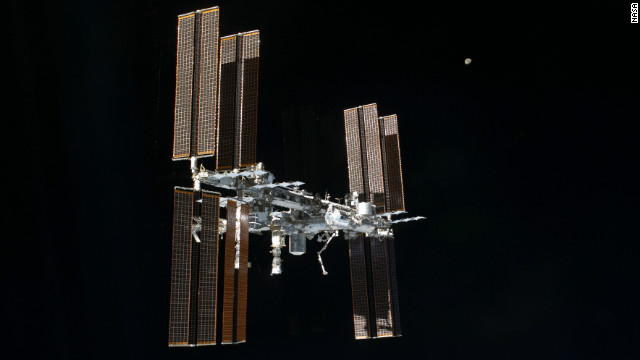
haven't learned not to fly within eyeshot of a space station the size of
a football field (including the end zones).
Or they may just like watching themselves live on the Internet.


No comments:
Post a Comment